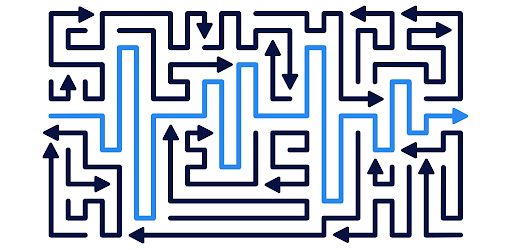
Arrows – Puzzle Escape is built around a simple idea: extract arrows from a grid without causing collisions. Its store description promises minimalist presentation, increasing complexity, a hint system and a relaxed pace, while its listed skill tags focus on planning, strategy, logic and reasoning. That makes it an appealing candidate for people who want a quiet puzzle workout rather than a frantic reflex test—but the game should be judged as a focused puzzle experience, not as a proven way to upgrade every aspect of cognition.
- Directory rating
- ★ 4.7 / 5 (2.6M votes)
- Price
- Free
- Platforms
- App Store, Google Play
- Developer
- Lessmore GmbH
- Released
- 2025
- Verdict: A promising free choice for players who enjoy planning-based logic puzzles and spatial problem-solving.
- The central challenge is to extract arrows without causing collisions, according to the store description.
- The game’s claims about thousands of handcrafted levels, increasing complexity, hints and no timers come from marketing text and have not been independently verified here.
- It plausibly exercises skills used during play, especially planning, visual tracking, reasoning and problem-solving.
- Research on cognitive training suggests that benefits are usually strongest on practiced or closely related tasks, so do not expect a general intelligence boost.

What is Arrows – Puzzle Escape?
Arrows – Puzzle Escape is a free puzzle game by Lessmore GmbH, released in 2025 for the App Store and Google Play. The supplied listing places it in both Puzzle Games and Brain Training, with Planning & Strategy and Logic & Reasoning as its skill tags.
Its reception is notably strong in the supplied store data: the overall rating is 4.7 out of 5 from 2,580,639 votes. The App Store listing is shown at 4.9, while Google Play is listed at 4.7. Ratings can tell you that a large number of players responded positively, but they do not explain which parts of the experience they liked, how difficult the puzzles become or whether the game suits your preferred style of thinking.
The store description presents the game as minimalist, calm and focused. It says the goal is to extract each arrow without causing a collision, and it frames the experience as suitable for both short sessions and longer challenges. Those are useful signals about the intended mood, but they remain claims from the store description rather than independently verified features.
How it plays
The supported gameplay loop is straightforward. You examine a puzzle grid, work out how the arrows can be removed, and try to extract them without creating a collision. The basic rule sounds easy to understand, but the difficulty comes from sequencing: a move that looks safe in isolation may interfere with another arrow’s route.
That structure puts the emphasis on planning before action. Instead of simply looking for a matching tile or reacting to a rapidly changing screen, you are encouraged to form a mental model of the board and anticipate consequences. In practical terms, each puzzle can feel like a small route-planning problem, with the grid acting as a compact battlefield and each arrow as a piece whose path must be respected.
The listing says that the puzzles increase in complexity and that the game contains thousands of handcrafted levels. Because this information comes from marketing text, it is best treated as the publisher’s description rather than a verified audit of the level count or design process. Still, the intended progression is clear: early puzzles should introduce the idea, while later puzzles are presented as more demanding tests of planning and logic.
The description also mentions a hint system. That could make the game more approachable when a puzzle becomes a boss fight rather than a quick win. However, the supplied data does not explain how hints work, whether they reveal a full move, remove part of the challenge or carry any cost. It is safest to say only that a hint system is advertised.
Before making a move, scan the whole grid and identify which arrows appear blocked by others. Treat the first move as a planning decision, not a reflex tap. This habit can make the puzzle feel less like trial and error and more like solving a compact logic proof.
Which cognitive skills might it exercise?
Arrows – Puzzle Escape is a plausible match for several skills, based on the game’s stated goal and tags. That does not prove that playing it produces lasting improvements in those abilities. It means the act of solving its puzzles appears to require or engage certain mental processes.
| Skill | Why it fits the game | What to keep in mind |
|---|---|---|
| Planning and strategy | You need to consider the order of moves and possible collisions. | Planning inside the game may not automatically transfer to unrelated real-world decisions. |
| Logic and reasoning | You must infer which moves are legal or safe from the arrangement of arrows. | Improvement may be strongest for similar puzzle structures. |
| Visual-spatial processing | The grid and arrow paths require attention to position, direction and obstruction. | The supplied listing calls this spatial thinking, but does not provide formal testing results. |
| Problem-solving | Each board presents a goal, constraints and a route toward completion. | Success can reflect familiarity with the game’s rules as well as broader reasoning. |
| Persistence and error monitoring | Complex boards may require checking consequences and revising a plan. | These are sensible gameplay interpretations, not measured outcomes for this title. |
Planning and strategy
Planning involves choosing actions while considering what may happen next. Arrows – Puzzle Escape appears to use this skill directly because a collision can make a sequence fail. The game therefore gives players a reason to pause, forecast and compare possible orders of operation.
That is different from saying the game teaches planning in every setting. A player may become better at recognizing the specific patterns used by arrow puzzles without becoming better at managing a project, organizing a trip or making a difficult life decision. Those broader outcomes would require separate evidence.
Logic and reasoning
Logic is also a natural fit. The player has a clear objective and a constraint: arrows must be extracted without collisions. Solving the board involves working out which moves are compatible and which apparent solutions will fail.
This kind of reasoning can be satisfying because it turns confusion into structure. You begin with a crowded grid, identify dependencies and gradually reduce the number of possible moves. The pleasure comes from finding the hidden order, not from speed alone.
Spatial thinking
The description explicitly mentions spatial thinking, and the grid-based format supports that interpretation. Players need to track where arrows sit, how paths relate to one another and how moving one element may change the available space around another.
Spatial practice is one area where research on games has reported promising findings, but results depend heavily on the type of game, the comparison task and the study design. A spatial puzzle should not automatically be treated as equivalent to a validated spatial-skills training program.
Research on games and cognition often distinguishes between near transfer and far transfer. Near transfer means getting better at a similar task; far transfer means carrying a benefit into a very different ability or real-world activity. Reviews generally find more support for task-specific or closely related improvements than for broad, reliable changes across cognition. (pmc.ncbi.nlm.nih.gov)
Play Quick Math free on Mentometry — no download, and your score joins the global leaderboard.
What does the research say about brain games?
The general research picture is mixed, which is important for evaluating any game marketed as brain training. Some studies and reviews report improvements in particular abilities after structured game-based training, including attention, processing speed, working memory or executive functions. Other work finds that the effects are limited, inconsistent or closely tied to the trained task.
A systematic review of serious games reported promising improvements in attention and executive functions, but emphasized that the strongest evidence was for near transfer and that far transfer and long-term effects remained limited or in need of further study. (pmc.ncbi.nlm.nih.gov) This is a useful frame for Arrows – Puzzle Escape: it may provide repeated practice in analyzing arrow arrangements, but there is no supplied evidence that the game changes unrelated abilities.
A 2026 systematic review and meta-analysis of board-game interventions reached a similarly cautious conclusion. It found promising results in some areas, including visuospatial short-term memory in kindergarten and processing speed in older adults, but said the evidence was not yet sufficient for a strong recommendation and noted substantial variation between studies. (pubmed.ncbi.nlm.nih.gov) Board games are not identical to a mobile arrow puzzle, so these findings should not be presented as evidence that this particular game works.
Other reviews have found that game-based training can improve selected outcomes in older adults, such as processing speed, selective attention and short-term memory. One review also reported that non-time-pressure designs were among the features associated with favorable outcomes in the studies it examined. (sciencedirect.com) That may make the advertised calm, no-timer format interesting from a design perspective, but it still does not establish that Arrows – Puzzle Escape produces the same effects.
The most defensible conclusion is modest. Playing a puzzle that repeatedly asks you to plan around constraints can give you practice with that type of problem. It can also be mentally engaging, provide a structured break and offer a satisfying sense of progress. Those are worthwhile reasons to play, but they are not the same as proof of general cognitive enhancement.
There is no evidence in the supplied data that Arrows – Puzzle Escape raises intelligence, prevents cognitive decline or treats a medical condition. More broadly, the World Health Organization has said that it remains unclear whether cognitive training reduces cognitive decline or dementia onset, partly because studies vary in methods and often lack long-term follow-up. (cdn.who.int)
Pros and cons
- Free to play on both the App Store and Google Play.
- A clear central objective: extract arrows without causing collisions.
- Strong listed player reception, with a 4.7 out of 5 rating from more than 2.5 million votes in the supplied data.
- Planning, logic and spatial thinking are built into the advertised puzzle concept.
- The minimalist and no-pressure presentation may appeal to players who prefer calm concentration over fast reactions.
- An advertised hint system may help when a board becomes difficult.
- The description claims increasing complexity and thousands of handcrafted levels, suggesting a substantial intended challenge.
- The level count, handcrafted status and exact progression are marketing claims rather than independently verified information here.
- The supplied description does not explain the detailed control scheme or the precise consequences of a failed move.
- There is no evidence that the game improves general intelligence or broad everyday reasoning.
- Players who dislike repetitive grid puzzles may find the core loop narrow over time.
- The overall rating does not reveal how the difficulty curve, hints or later puzzles perform for individual players.
- The game’s brain-training label may encourage expectations that go beyond what the evidence supports.
Who should play it?
Arrows – Puzzle Escape looks best suited to players who enjoy quiet, rule-based puzzles and like thinking several moves ahead. It may be a good fit if you prefer a clean challenge that can be approached in short sessions, especially because the store description presents it as suitable for both a few minutes and longer play.
It is also a reasonable choice for people who want to exercise a specific style of attention: inspecting a visual arrangement, identifying constraints and testing a sequence. If you enjoy the feeling of clearing a stubborn board one careful move at a time, the game’s premise should be appealing.
It may be less suitable for players looking for social competition, narrative progression, action or fast reaction tests. The supplied data describes a minimalist puzzle experience, not a story-driven game or a multiplayer contest. Likewise, anyone looking for a clinically validated cognitive program should not treat a general app-store puzzle as a substitute for one.
A practical way to play
- Start by reading the board as a whole instead of immediately moving the most obvious arrow.
- Look for arrows whose paths appear to depend on another arrow being removed first.
- Before committing, predict what space or route the move will open.
- Use the advertised hint system when you are genuinely stuck, rather than turning every puzzle into blind experimentation.
- After solving a board, briefly identify the key dependency that made the solution work.
For your next three puzzles, pause before the first move and name the arrow you think must be handled first. After each board, check whether your prediction was correct and why.
ALSO READ Inside Sequence Memory: The Science Behind the Game and What Your Score Really Measures
Similar alternatives
For a similar arrow-focused experience, Arrow Puzzle: Tap Puzzle Games is the closest alternative in the supplied data. Its description also centers on finding a free path and tapping arrows in the right order, so it should appeal to players who want another logic challenge built around arrow sequencing. It is free on Google Play and has a listed rating of 4.8 out of 5 from 1,444,087 votes. Its supplied skill tag is Logic & Reasoning, while Arrows – Puzzle Escape also lists Planning & Strategy.
Block Blast! offers a different puzzle language. Its description presents block-crush gameplay in which every move is framed as a test of brain and strategy. It is free on the App Store and Google Play, with a listed rating of 4.9 out of 5 from 8,281,701 votes. Choose it if you want a block-based alternative rather than another arrow-grid challenge.
 Puzzle Games · Brain TrainingBlock Blast!HungryStudio★ 4.9 (8.3M votes)View ratings & details ▶
Tile Explorer – Triple Match is another free option, but its supplied description points toward a relaxing tile match-3 experience rather than route planning. It is listed for Google Play with a 4.9 out of 5 rating from 2,280,231 votes. It may suit players who want a more casual matching loop and a different kind of visual sorting challenge.

For a faster, more explicitly timed cognitive mini-game, Mentometry’s Quick Math asks you to judge whether a displayed equation is correct or incorrect before time runs out. That is a very different demand from Arrows – Puzzle Escape: speeded numerical decisions instead of deliberate spatial planning. It can complement a slower puzzle session if you want to vary the kind of attention you use.
Odd or Even is another short-format alternative. A number appears and you quickly decide whether it is odd or even, making it a compact test of rapid classification rather than arrow sequencing. It is useful as a change of pace when you want a brief, clearly defined mental task.
Final verdict
Arrows – Puzzle Escape has a solid premise for a brain-workout audience: a simple rule, a clear objective and a problem-solving loop that appears to reward planning before action. Its free price, broad mobile availability and very strong listed rating make it easy to try, while the advertised minimalist presentation and no-pressure format should appeal to players who prefer calm concentration.
The balanced view is that this is a puzzle game that plausibly exercises puzzle-relevant skills. It is not evidence-based proof of a general brain upgrade. If you approach it as a focused workout for planning, logic and spatial reasoning—with entertainment and satisfaction as the main rewards—it sounds like a worthwhile addition to a mobile puzzle rotation.
Frequently Asked Questions
Is Arrows – Puzzle Escape free?
Yes. The supplied data lists Arrows – Puzzle Escape as free on the App Store and Google Play.
What is the goal in Arrows – Puzzle Escape?
According to the store description, you must extract each arrow without causing a collision. The description also presents planning, logic and spatial thinking as central parts of the challenge.
Does Arrows – Puzzle Escape improve intelligence?
There is no evidence in the supplied data that it improves general intelligence. It is more accurate to describe it as a puzzle that may provide practice with planning, logic and visual-spatial problem-solving.
Is Arrows – Puzzle Escape good for brain training?
It may be useful as an engaging puzzle workout for the skills involved in its gameplay. Research generally finds stronger evidence for improvements on practiced or closely related tasks than for broad cognitive transfer.
Does Arrows – Puzzle Escape have hints?
Its store description advertises a hint system. The supplied information does not explain how the hints work or whether they have any cost.
What games are similar to Arrows – Puzzle Escape?
Arrow Puzzle: Tap Puzzle Games is the closest listed alternative because it also centers on finding paths and tapping arrows in the right order. Block Blast! and Tile Explorer – Triple Match offer different block and tile-based puzzle formats.
Sources
- The Benefits of Playing Video Games / American Psychological Association
- The Effects of Gamification on Computerized Cognitive Training: Systematic Review and Meta-Analysis / JMIR Serious Games
- The Effectiveness of Serious Games for Training of Attention and Executive Functions: A Systematic Review / peer-reviewed systematic review
- Can Executive Functions Be Improved by Playing Board Games Across the Lifespan? A Systematic Review and Meta-Analysis / Applied Psychology: Health and Well-Being
- Game-Based Brain Training for Improving Cognitive Function in Community-Dwelling Older Adults: A Systematic Review and Meta-Regression / Archives of Gerontology and Geriatrics
- Risk Reduction Guidelines for Cognitive Decline and Dementia: Cognitive Interventions / World Health Organization
- Risk Reduction of Cognitive Decline and Dementia: WHO Guidelines, Second Edition / World Health Organization
Educational content only; not medical or financial advice.


[…] ALSO READ Arrows – Puzzle Escape Review: Calm Logic, Real Limits […]
[…] ALSO READ Arrows – Puzzle Escape Review: Calm Logic, Real Limits […]