
Sudoku is a familiar puzzle format, but a familiar format can still make a useful mental workout. Sudoku.com – Sudoku Puzzle turns that format into a free mobile game with daily puzzles, six stated difficulty levels and a large library of classic number grids. The bigger question is what kind of workout it offers—and what it does not.
- Directory rating
- ★ 4.7 / 5 (2.5M votes)
- Price
- Free
- Platforms
- Google Play
- Developer
- Easybrain
- Released
- 2017
- Sudoku.com is a free Google Play puzzle game focused on classic Sudoku and number grids.
- Its supplied description claims more than 10,000 puzzles, six difficulty levels and offline availability, though store descriptions are marketing material rather than independent verification.
- Sudoku plausibly exercises logical reasoning, sustained attention, planning and working memory while you solve the puzzle itself.
- Research supports the idea that Sudoku engages these skills, but it does not justify claims that the game raises intelligence or broadly protects against cognitive decline.
- It is best for people who enjoy structured, low-pressure problem solving and want a portable puzzle habit.
What Sudoku.com – Sudoku Puzzle is
Sudoku.com – Sudoku Puzzle is a puzzle game by Easybrain, listed under Puzzle Games and Sudoku & Number Grids. The supplied game data lists it as free, available on Google Play, and released in 2017. Its skills tags are Logic & Reasoning and Math & Numeracy.
The store description presents it as a classic Sudoku game for beginners and advanced players. It says the app includes daily Sudoku puzzles, more than 10,000 classic number games and six difficulty levels: fast, easy, medium, hard, expert and giant. Those statements come from the store description and should be treated as marketing claims, not as independently tested features.
At the time of the supplied data, the game carries a 4.7/5 rating from 2,499,089 votes. That is a large amount of user feedback and suggests broad appeal, but a store rating cannot tell you whether the app’s puzzle quality, presentation or difficulty will suit your particular taste.

How it plays
The available description supports a straightforward picture: you solve classic Sudoku number puzzles, choose among stated difficulty levels and can use the game for a short break or a longer session. It also says the game includes daily puzzles and is available offline. The description compares the mobile experience with using pencil and paper, which points to a traditional puzzle-first experience rather than an action game.
That simplicity is part of the appeal. Sudoku gives you a contained problem, a visible grid and a clear objective. Each placement changes the information available elsewhere, so a small deduction can open a new route through the puzzle. The experience is less like racing through a level and more like slowly unlocking a puzzle room.
The six named difficulty levels provide a natural progression from easier starting points to more demanding challenges. However, the supplied information does not explain exactly how those levels differ, how the “giant” category works, or whether difficulty is measured by grid size, solving technique or another system. It is better to treat the labels as broad guidance rather than a guaranteed difficulty standard.
Choose a difficulty that makes you think without forcing constant guessing. The most useful session is usually one where you practise checking possibilities and revising your plan, not one where you rush to finish.
Which cognitive skills might it exercise?
Sudoku.com is tagged for logic and reasoning, math and numeracy. Those tags fit the basic demands of Sudoku, although the game should be understood as a puzzle that exercises these skills during play—not as a general-purpose test or treatment.
Logical reasoning
Sudoku requires you to work within a set of constraints. You inspect the available information, eliminate options and select a placement that fits the puzzle’s rules. This is a practical form of deductive reasoning: the goal is not to calculate a large numerical answer but to infer what is possible and what is ruled out.
The reasoning is often sequential. One conclusion can change the possibilities in another part of the grid, which means that solving involves tracking consequences over time. That makes Sudoku a plausible way to practise structured problem solving in a narrow, clearly defined environment.
Working memory and attention
While solving, you may need to hold several possible numbers in mind, remember which rows or columns you have checked and keep track of a developing chain of deductions. That places demands on working memory, the ability to hold and manipulate information over short periods. Working memory is also closely involved in reasoning, mental arithmetic and comparing alternatives. (pmc.ncbi.nlm.nih.gov)
Attention matters too. A careless scan can make you overlook a contradiction or repeat a number. Sudoku therefore encourages sustained focus and selective attention, especially when the puzzle becomes dense and the obvious placements run out.
Planning and cognitive flexibility
Good solving is not always a straight line. You may switch from examining a row to checking a block, change your preferred solving strategy or revisit an earlier assumption. Those behaviours resemble aspects of executive function, a group of mental control processes that includes working memory, inhibition and cognitive flexibility. (pmc.ncbi.nlm.nih.gov)
That does not mean every Sudoku session trains every part of executive function equally. It means the activity naturally recruits some of the same processes used for monitoring, updating information and staying on task.
Numeracy, with an important qualification
Sudoku uses numbers, but it is not primarily an arithmetic game. The numbers function as symbols in a logical arrangement. You do not normally add, subtract or multiply to solve a standard grid. For that reason, Sudoku may provide practice with numerical symbols, ordering and rule-based comparison, but it should not be treated as a substitute for broader mathematical practice.
| Skill area | Why Sudoku may involve it | What the game should not be assumed to do |
|---|---|---|
| Logical reasoning | Eliminating possibilities and drawing rule-based conclusions | Raise general intelligence |
| Working memory | Holding candidates and previous deductions in mind | Produce broad memory gains in unrelated tasks |
| Attention | Scanning the grid and monitoring for conflicts | Replace sleep, exercise or other foundations of cognitive health |
| Numeracy | Handling numerical symbols and structured patterns | Teach arithmetic or advanced mathematics |
| Cognitive flexibility | Changing focus and revising a solving approach | Guarantee improvements in everyday decision-making |
Research on Sudoku as a cognitive task links solving with working memory, reasoning and executive processes. Brain-imaging research has also reported activity in frontoparietal networks involved in cognitive control and numerical or visuospatial processing. These findings show that Sudoku is mentally demanding; they do not prove that playing one app produces lasting, general improvements. (pmc.ncbi.nlm.nih.gov)
Play Odd or Even free on Mentometry — no download, and your score joins the global leaderboard.
What the research says about brain workouts
The most defensible claim is specific: solving Sudoku exercises the mental operations required to solve Sudoku. Research can also show that people who perform well on Sudoku tend to use or possess abilities related to working memory, reasoning and executive control. That is different from proving that repeated play transfers to every area of thinking.
Studies of number-puzzle habits have found associations between frequent puzzle use and performance on several cognitive measures. But an association does not establish that puzzles caused the difference. People who choose puzzles regularly may also differ in education, leisure time, motivation, health, technology use or other factors that affect test performance. (pubmed.ncbi.nlm.nih.gov)
Training research is especially important here. Meta-analytic work on working-memory training has found that improvements are most reliable on tasks similar to the activities practised, while evidence for broad transfer to unrelated abilities is much weaker. In one major review, the strongest study designs did not provide evidence for transfer to nonverbal ability. (apa.org)
Sudoku-specific evidence remains limited and mixed. A recent systematic review of Sudoku brain-imaging studies described consistent engagement of networks associated with working memory and executive control, but also noted the small and varied nature of the evidence base. A recent randomized trial in people receiving hemodialysis reported no clear pre-to-post improvement in memory within the Sudoku group, despite differences between groups in the study’s analyses. That population and design do not tell us how Sudoku.com will affect healthy users, but they reinforce the need for modest claims. (pmc.ncbi.nlm.nih.gov)
Sudoku can be a meaningful mental challenge without being a proven intelligence booster. Think of it as practising a specific puzzle skill and enjoying focused problem solving—not as a guaranteed upgrade to every cognitive ability.
Pros and cons
- Free to play according to the supplied data.
- Large user rating base, with a listed score of 4.7/5 from 2,499,089 votes.
- Classic Sudoku format is easy to understand and difficult to master.
- Six named difficulty levels may help players find a suitable challenge.
- The store description claims daily puzzles and offline availability.
- Its logic-and-reasoning focus makes it a sensible choice for structured mental engagement.
- The available platform data lists Google Play only.
- The store description is marketing text and does not independently verify the claimed puzzle count or features.
- Sudoku exercises a relatively narrow set of skills compared with a varied cognitive routine.
- Using numbers does not make it an arithmetic-training game.
- Research does not justify claims of higher intelligence or broad protection against cognitive decline.
- The supplied data does not explain the exact difference between difficulty levels.
Who should play it?
Sudoku.com is a good fit for adults who enjoy quiet, rule-based puzzles and want a portable way to spend a few focused minutes. It may also suit beginners who want a familiar format with several stated difficulty labels, as well as experienced solvers looking for a large collection of classic number grids.
It is less suitable if your main goal is broad cognitive variety. Sudoku does not cover language, visual matching, reaction speed or arithmetic in any deep way. A balanced routine can include different kinds of tasks so that you are not repeatedly practising only one puzzle format.
It is also worth choosing the game because you enjoy it. Enjoyment can make a habit easier to maintain, but enjoyment should not be confused with proof of a health outcome. If a puzzle feels frustrating, switching to an easier level is not “failing”; it is adjusting the challenge so that the session remains constructive.
A practical way to use it
- Start with a difficulty level that feels demanding but understandable.
- Work slowly enough to check each deduction rather than filling spaces at random.
- When stuck, review the grid and identify which information you may have overlooked.
- Stop after a short session if concentration is fading; longer play is not automatically better.
- Rotate Sudoku with other kinds of cognitive activities for broader variety.
Complete one puzzle without guessing. When you get stuck, spend two minutes reviewing rows, columns and sections before making any speculative move.
For variety, try a quick activity that uses a different response style. Odd or Even asks you to identify whether a flashing number is odd or even, making it a compact exercise in rapid numerical classification.
Pattern Match shifts the emphasis from number-grid deduction to visual comparison: study a pattern, then select the matching option. It is a useful change of pace when you want a different kind of attention challenge.
ALSO READ Inside Grid Memory: The Science Behind the Game and What Your Score Really Measures
Similar alternatives
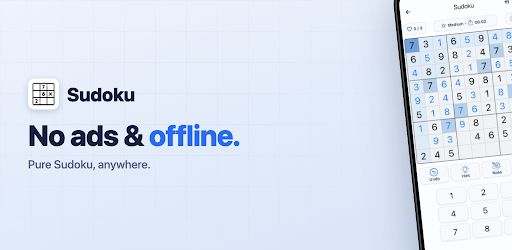
Sudoku – Classic Number Puzzle by Rubigo Games is another free Google Play Sudoku title in the same Puzzle Games and Sudoku & Number Grids category. Its supplied store description emphasizes a no-ads, no-distractions approach, but that statement is marketing text and has not been independently verified here. The listed rating is 5.0/5 from 596 votes, with a 2025 release year.
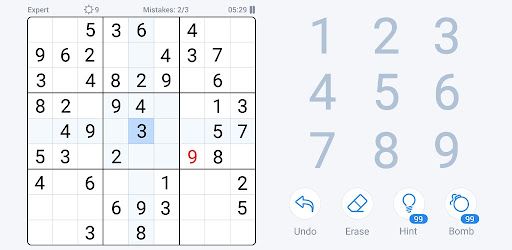
Sudoku Game – Daily Puzzles by GamoVation is also free on Google Play and carries the same Logic & Reasoning and Math & Numeracy skill tags. Its description says it offers thousands of puzzles and online or offline play; again, these are store-description claims. The supplied rating is 4.8/5 from 250,925 votes, and the game is listed as a 2022 release.
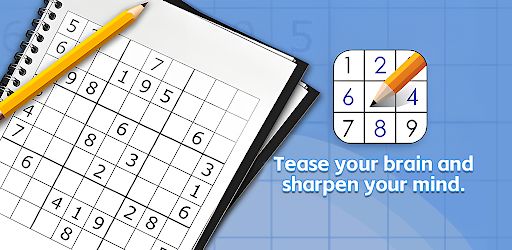
Sudoku – Classic Sudoku Puzzle by Oakever Games is another free Google Play option. The supplied description highlights classic Sudoku, offline play and an ad-free experience, while the listed rating is 4.7/5 from 3,049,567 votes. Like the other alternatives, it belongs to the same puzzle category and carries the same two skill tags.
Verdict
Sudoku.com – Sudoku Puzzle is a sensible choice if you want a free, familiar number puzzle that can occupy a short break or a longer focused session. Its stated daily puzzles, offline availability and six difficulty labels give it a practical shape, while its very large rating base suggests that the format has broad appeal.
As a brain workout, its value is real but specific. Sudoku can engage logic, attention, working memory and planning while you solve the grid. The research supports describing those demands, but not promising that the app will raise intelligence, prevent decline or transform unrelated abilities.
That makes Sudoku.com best viewed as one tool in a varied mental-gaming routine. If you enjoy the gradual climb from easy placements to a full-grid boss fight, it earns a recommendation—provided you play for the challenge rather than an exaggerated promise.
Frequently Asked Questions
Is Sudoku.com – Sudoku Puzzle free?
The supplied game data lists Sudoku.com – Sudoku Puzzle as free. It is listed for Google Play.
Is Sudoku good for your brain?
Sudoku is a focused puzzle that plausibly exercises logical reasoning, attention, working memory and planning while you solve it. Research does not support treating it as a guaranteed way to improve intelligence or prevent cognitive decline.
Does Sudoku improve memory?
Sudoku requires you to hold possible moves and previous deductions in mind, so it uses working memory during play. That is not the same as proving lasting improvement in memory across unrelated tasks.
Is Sudoku a math game?
Sudoku uses numbers as symbols, but solving it is mainly about logic and constraint-based reasoning rather than arithmetic. It may involve numerical comparison without teaching broader mathematics.
What difficulty levels does Sudoku.com have?
The supplied store description names six levels: fast, easy, medium, hard, expert and giant. The available data does not explain precisely how the levels differ.
What are alternatives to Sudoku.com?
The supplied alternatives are Sudoku – Classic Number Puzzle, Sudoku Game – Daily Puzzles and Sudoku – Classic Sudoku Puzzle. All are listed as free Google Play Sudoku games with Logic & Reasoning and Math & Numeracy skill tags.
Sources
- Executive Functions / Annual Review of Psychology, Adele Diamond
- Is Working Memory Training Effective? A Meta-Analytic Review / Developmental Psychology
- Neural Correlates of Sudoku Play: A Systematic Review of Brain Imaging Studies / systematic review indexed in PubMed Central
- The Relationship Between the Frequency of Number-Puzzle Use and Baseline Cognitive Function in a Large Online Sample of Adults Aged 50 and Over / International Journal of Geriatric Psychiatry
- The Effect of Sudoku Puzzle Solving on Memory and Anxiety of Hemodialysis Patients: A Randomized Controlled Clinical Trial / International Urology and Nephrology
This is educational content, not medical or financial advice.


[…] ALSO READ Sudoku.com Review: Is It a Good Brain Workout? […]