
Everyday life is full of visual search missions: finding your car in a crowded parking lot, locating a familiar face at a station, spotting a cyclist while driving, or picking one product from a packed shelf. The eyes take in a scene, but the mind still has to decide what matters, where to look, and when the search is complete. That combination of perception, attention, memory and decision-making is called visual search.
- Visual search is the process of finding a relevant target among competing visual information.
- Search can be guided by the target’s features, the surrounding scene, past experience and the observer’s goals.
- Researchers commonly measure reaction time and accuracy while varying the number and type of distractors.
- Practice can improve performance on trained or closely related searches, but broad transfer is limited and highly dependent on the task.
- Short games can provide structured practice and feedback, but they should be treated as skill-specific exercises rather than general intelligence boosters.
What visual search means in cognitive science
Visual search is not simply “looking harder.” It is a selective-attention problem: the visual system must prioritize some information while suppressing or ignoring other information. A typical laboratory task presents a target, such as a tilted line or a particular letter, among distractors. The participant must report whether the target is present, identify it, or locate it as quickly and accurately as possible. (annualreviews.org)
The target is represented by a search template or goal. If you are looking for a red suitcase, your mind can use color, shape, size and context to guide the search. That guidance is not fixed. It changes with instructions, expectations, recent experience, reward and the meaning of the scene. Modern models therefore describe search as an interaction between fast feature processing and slower, goal-directed selection rather than as a simple scan from left to right. (pmc.ncbi.nlm.nih.gov)
Pop-out, conjunction and difficult searches
Some targets appear to “pop out.” A single red item among many green items may be detected quickly because color provides a strong distinguishing feature. In these conditions, adding more distractors may have only a small effect on response time.
Other searches require combining features. Finding a small red triangle among red circles and small green triangles is harder because no single feature identifies the target. The observer must combine color and shape, use a more specific search strategy, and sometimes inspect several candidates. The difficulty depends not only on the target but also on distractor similarity, spacing, clutter and the observer’s knowledge of the task. (sciencedirect.com)
Feature Integration Theory helped establish the idea that basic visual features can be processed differently from feature combinations. Guided Search models developed this picture by emphasizing that attention is guided by several sources at once, including visual salience, goals, memory, reward and scene meaning. These models are influential frameworks, not a claim that every search follows one rigid sequence.
Why visual search matters outside the laboratory
Visual search helps people extract useful information from clutter. A driver searches for pedestrians, signs and hazards while monitoring motion and road position. A shopper searches packaging for a particular brand or ingredient. A football or basketball player scans for teammates, opponents and open space. In each case, the target may move, appear briefly or be partly hidden.
Professional settings make the stakes clearer. Aviation security, radiology, military monitoring, lifeguarding and other occupations require observers to detect important items among many ordinary items. Research reviews describe visual search as central to these roles, while also noting that effective training must address search strategy and decision-making, not just speed on a familiar display. (sciencedirect.com)
Visual search also matters in ordinary digital environments. Notifications, icons, menus and dashboards compete for attention. A person may know exactly what they are looking for and still miss it because it is visually similar to nearby items, appears in an unexpected location, or is surrounded by more salient distractions.

When a search matters, define the target before you begin. Decide which features count, what nearby items might be confused with it, and what evidence will tell you that the search is complete. A clear search template can be more useful than simply moving your eyes faster.
How researchers measure visual search
Researchers usually manipulate the display and measure performance under controlled conditions. The most common outcomes are reaction time, accuracy and the relationship between reaction time and the number of items in the display, known as set size. Comparing these conditions helps separate search efficiency from simple guessing or general motor speed. (pmc.ncbi.nlm.nih.gov)
| Measure | What it captures | Important caution |
|---|---|---|
| Reaction time | How quickly a participant responds | Can improve through familiarity, motor practice or a speed–accuracy trade-off. |
| Accuracy | Whether the target was correctly detected or identified | A fast score is not meaningful if errors increase. |
| Set-size slope | How much response time changes as more items are added | Depends on target presence, display design and search strategy. |
| Target-present versus target-absent performance | How search termination and decision-making affect results | Absent trials can require a more exhaustive search. |
| Eye movements | Where and when attention is deployed overtly | Looking at an item does not guarantee that it was fully processed. |
The logic of the set-size slope
Suppose a participant searches displays containing 4, 8, 16 or 32 items. If reaction time barely changes as the display gets larger, the search is relatively efficient under those conditions. If reaction time rises steeply, the observer may be inspecting more items, facing stronger competition, or using a less effective search strategy.
Researchers often calculate the slope of the reaction-time function. Classic reviews describe slopes in milliseconds per additional item as a useful index of how strongly search time is affected by display size, while emphasizing that the interpretation depends on the task. Target-absent trials often take longer because the observer must gather enough evidence that the target is not present. (pmc.ncbi.nlm.nih.gov)
Accuracy is essential. A participant can appear faster by responding before the search is complete. Good experiments therefore examine speed and accuracy together, use balanced target-present and target-absent trials, and control for practice, fatigue, screen layout and response compatibility.
What changes search performance?
Search is shaped by both bottom-up and top-down influences. Bottom-up factors include contrast, color, motion, size and physical salience. Top-down factors include the target description, current goals, expectations and knowledge of likely locations. Neither influence operates in isolation: a visually striking object may attract attention, but a strong goal can redirect attention toward something less conspicuous. (pmc.ncbi.nlm.nih.gov)
Similarity is especially important. A target that differs sharply from its distractors is usually easier to detect than one that shares many features with them. Clutter, crowding, low contrast and unusual viewpoints can make a familiar object harder to find. Peripheral vision can support useful search information, but it is not a perfect substitute for focused inspection; what can be detected away from fixation depends on the item, context and task. (nature.com)
Experience also changes search. Repeated arrangements can teach the visual system where targets are likely to appear. This phenomenon, often called contextual cueing, shows that learned scene regularities can guide attention and speed search, sometimes without deliberate recollection of the learned arrangement. (sciencedirect.com)

For one minute, choose a familiar visual environment and name three target features before searching. Then change one feature, such as color or shape, and notice how your search strategy changes.
Play Color Clash free on Mentometry — no download, and your score joins the global leaderboard.
What published research says about training visual search
The evidence supports a careful conclusion: visual search can improve with practice, but the improvement is often tied to the trained task, stimulus or strategy. Perceptual-learning studies have found that practice can make some searches faster and more efficient. In some experiments, initially inefficient feature searches became more parallel after relatively limited practice, and learning could persist over time or transfer across certain locations and task variations. (sciencedirect.com)
However, transfer is not automatic. Other studies have found that learning may be specific to particular features, locations or task demands, with some conditions showing little transfer or even poorer performance when the task changes. The balance between generalization and specificity appears to depend on factors such as task difficulty, feature reliability, training design and how similar the new task is to the trained one. (sciencedirect.com)
Training in professional settings illustrates the same point. Practising with the exact equipment, target categories and environments used on the job can be valuable. Yet training that teaches a flexible search strategy may be more durable than memorizing a fixed display or a narrow set of examples. Reviews caution that short-term gains do not necessarily produce broad, long-term transfer to every real-world situation. (sciencedirect.com)
Where game-based practice fits
A short game can offer repeated trials, immediate feedback and a clear performance signal. That makes it a reasonable way to practise a narrow component of attention, especially when the task requires selecting one relevant feature while ignoring competing information. It can also make practice easier to repeat than a paper exercise.
Color Clash trains response selection when a word and its ink color conflict. It is best understood as practice for resisting interference and selecting the task-relevant visual feature, not as a complete visual-search assessment. Use it for short, accurate sessions and track whether speed improves without sacrificing correctness.
Flanker Arrows focuses on selecting the central arrow while ignoring surrounding arrows. This overlaps with selective attention and distractor suppression, which are important ingredients in many searches, although the task is more controlled than searching a natural scene.
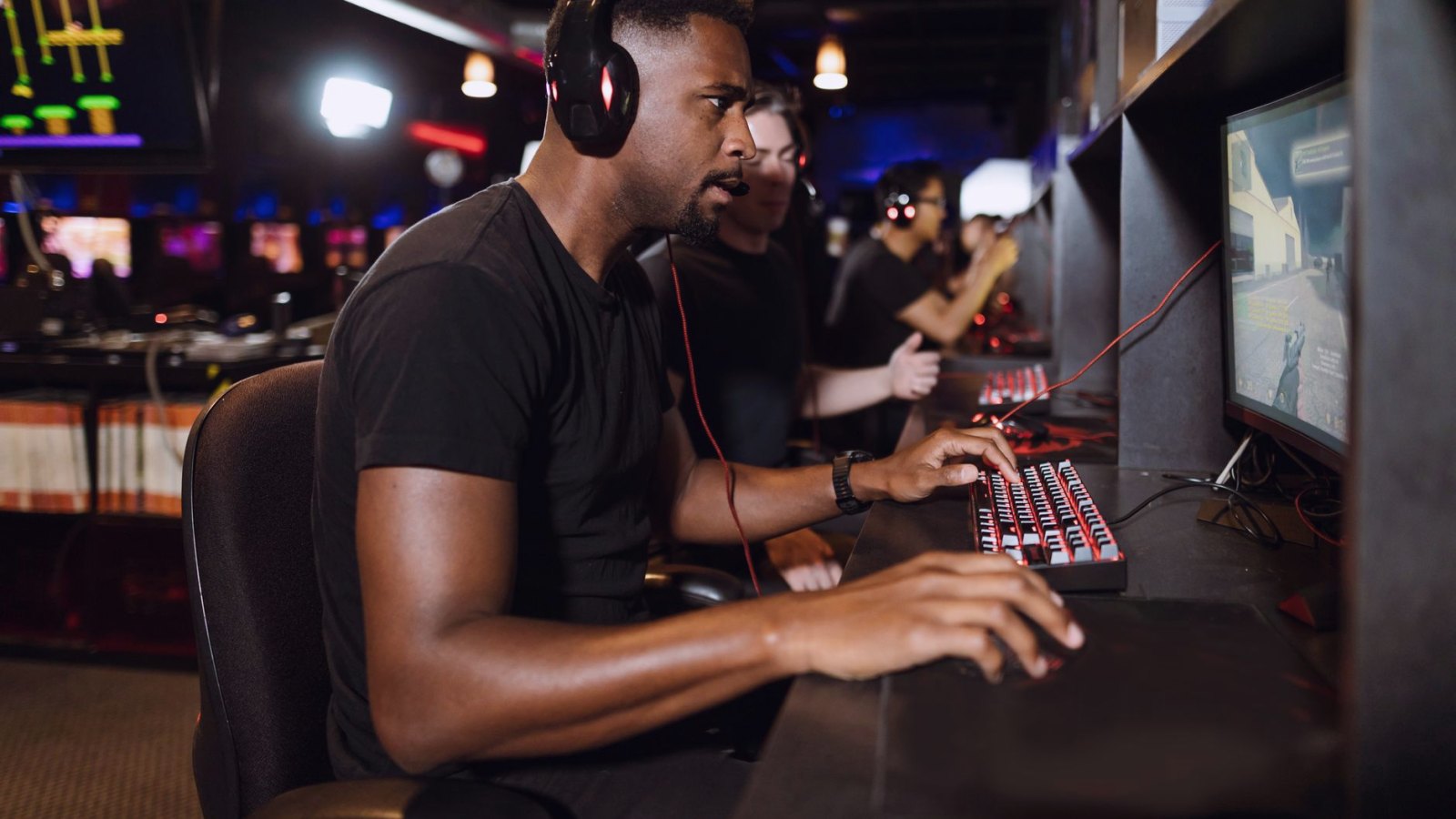
These games can help you measure performance on their own rules. They cannot establish that your driving, shopping, sports performance or general intelligence has improved. To test broader transfer, you would need a separate task with new stimuli and demands, ideally with an appropriate comparison and repeated measurements.
Getting better at a game often means getting better at that game. That is not a failure; task-specific learning is a real form of learning. The mistake is treating a higher game score as proof of broad cognitive improvement without testing the other skill directly.
How to practise visual search in an evidence-aligned way
The most useful practice is specific enough to target a skill but varied enough to avoid memorizing one display. A practical routine can combine controlled game practice with everyday searches that require different targets, locations and levels of clutter.
- Choose one search component. Decide whether you are practising target detection, distractor suppression, feature binding, speed, accuracy or search strategy.
- Start with accuracy. Reduce speed pressure until you can follow the rule reliably. Fast errors are not efficient search.
- Vary the conditions. Change target color, location, size, orientation and distractor similarity where possible.
- Use brief sessions. Stop when attention becomes unreliable. Fatigue can make a score look like a measure of skill when it is really a measure of endurance.
- Test a new task. After practice, try an unfamiliar search with different objects and rules. Treat any improvement as evidence about transfer, not as a guaranteed result.
- Record more than speed. Note accuracy, false alarms, missed targets and whether performance changes with clutter.
A good practice plan resembles a well-designed game level: it introduces one challenge, then changes the environment enough to test whether the player learned a strategy rather than memorized the map.
- Provides repeatable trials and immediate feedback.
- Can target interference control and selective attention.
- Makes short practice easier to maintain.
- Allows simple tracking of speed and accuracy.
- May reward familiarity with one rule or interface.
- Usually measures a narrower skill than real-world search.
- Transfer to unrelated tasks is uncertain.
- Speed scores can hide accuracy problems.
ALSO READ Working Memory Capacity: The Real Limit Is Not Seven Items
Common misconceptions about visual search
“Visual search is just eyesight.”
Clear vision helps, but search also depends on attention, working memory, expectations, decision criteria and knowledge of the target. Two people with similar visual acuity can search differently because they use different templates or strategies.
“The fastest person has the best search skill.”
Speed matters, but so do misses and false alarms. In a safety-critical setting, a fast response that overlooks the target may be worse than a slower, accurate response. Researchers therefore interpret reaction time alongside accuracy and task conditions.
“Pop-out means attention is unnecessary.”
Some distinctive features can guide attention rapidly, but search still occurs within a task and context. Expectations, target definitions, distractor similarity and the need to identify or respond to the item can all affect performance.
“More practice always creates broad improvement.”
Practice can produce meaningful gains, but published research shows that transfer varies. Improvements are often strongest when the new task shares features, strategies or decision demands with the training task. Far transfer to unrelated abilities remains difficult to demonstrate consistently across cognitive-training research. (pmc.ncbi.nlm.nih.gov)
“A brain game can prevent cognitive decline or treat a condition.”
That claim goes beyond what a short visual-attention game can establish. Game performance can provide practice and a narrow performance metric, but it is not a diagnosis, treatment or guarantee of protection against disease.
How to interpret your own scores
Personal scores are most useful when treated as repeated observations rather than as a permanent label. Compare yourself under similar conditions, look for trends across several sessions, and note whether accuracy remains stable as speed increases. A single unusually high or low result may reflect sleep, distraction, device differences or simple chance.
For a more meaningful self-check, alternate between familiar practice and unfamiliar tests. If performance improves only on the practiced rule, you have learned that rule. If some benefit appears on a new but related search, that suggests near transfer. If you want to claim improvement in an everyday ability, measure that ability directly rather than inferring it from a game score.
Think in terms of a personal “search profile.” Track accuracy, response speed, distractor difficulty and fatigue separately. A balanced profile is more informative than chasing one high score.
Conclusion: train the skill, keep the claim modest
Visual search is a core part of how people navigate busy environments. It combines visual discrimination with attention, memory, expectations and decisions about where to look next. Laboratory tasks have revealed important principles, including pop-out, feature conjunctions, set-size effects, contextual guidance and the difference between target-present and target-absent search.
Practice can sharpen performance on trained or closely related searches. Short games such as Color Clash and Flanker Arrows can make focused practice measurable and engaging, particularly for interference control and selective attention. The evidence supports using them as one tool in a broader routine—not as a cure-all, an intelligence upgrade or a substitute for testing the real-world ability you care about.
Player Two: Games to Try Next
Hand-picked from Mentometry and the Brain Games directory, matched to this article.
 Adventure & Point-and-Click · Hidden Object & Spot the DifferenceEscape Memoirs: Questionable Side Stories0 Deer Soft★ 4.8 (1.7K votes)View ratings & details ▶
 Educational · Brain TrainingInfinite Mind – Brain TrainingInfinite Mind LLC★ 4.9 (159 votes)View ratings & details ▶
 Brain TrainingPropel: ADHD Games for AdultsJupys★ 4.8 (913 votes)View ratings & details ▶
Frequently Asked Questions
What is visual search?
Visual search is the process of finding a relevant object or feature among competing visual information. It relies on perception, selective attention, memory, expectations and decision-making.
What is an example of visual search in everyday life?
Finding a friend in a crowd, spotting a road sign, locating an item on a supermarket shelf or identifying a hazard while driving are all examples. The task becomes harder when distractors resemble the target or the scene is cluttered.
Can visual search be improved with practice?
Yes, practice can improve performance on trained or closely related searches. Transfer to unfamiliar tasks is more limited and depends on how similar the new task is to the training task.
Do brain games improve visual search?
They can provide structured practice for specific components, such as ignoring distractors or selecting a relevant feature. A higher game score does not by itself prove improvement in general attention or real-world search.
How do scientists measure visual search?
Researchers commonly measure reaction time and accuracy while varying the number and similarity of items in the display. They may also compare target-present and target-absent trials and record eye movements.
Is visual search the same as eyesight?
No. Eyesight is important, but visual search also involves attention, expectations, working memory, strategy and decisions about where to look. Two people with similar visual acuity can perform differently on the same search task.
Sources
- “Visual Search: How Do We Find What We Are Looking For?” / Annual Review of Vision Science
- “Guided Search 6.0: An Updated Model of Visual Search” / Psychonomic Bulletin & Review
- “Moving Towards Solutions to Some Enduring Controversies in Visual Search” / Trends in Cognitive Sciences
- “Visual Search” / Cognitive Psychology review
- “Evaluation of Strategies to Train Visual Search Performance in Professional Populations” / Current Opinion in Psychology
- “Perceptual Learning in Visual Search Generalizes Over Tasks, Locations, and Eyes” / Vision Research
- “Perceptual Learning in Visual Search: Some Evidence of Specificities” / Vision Research
- “Mechanisms of Contextual Cueing: A Tutorial Review” / Attention, Perception, & Psychophysics
- “A Game-Factors Approach to Cognitive Benefits from Video-Game Training: A Meta-Analysis” / PLOS ONE
- “Video Game Training Does Not Enhance Cognitive Ability: A Comprehensive Meta-Analytic Investigation” / Psychological Bulletin
This article is educational content, not medical or financial advice.



[…] the cost of searching through clutter. The game does not reproduce a financial screen, and faster visual search does not demonstrate better interpretation of market […]
[…] and spot-the-difference games dominate this list, making visual search and sustained attention the main […]
[…] alongside vocabulary. The limitation is that it is not a pure reflex test; word knowledge and visual search are central to the experience. It is free and listed for the App Store, with a 4.7/5 rating from […]
[…] cognitive games may resemble parts of rapid decision-making, such as visual search, rule application and response […]
[…] displayed objects and choose the correct total. These tasks may exercise different combinations of visual search, attention, and counting, but practice on them should not be described as automatic training for […]
[…] is the speed–accuracy trade-off. It appears in laboratory tasks, visual search, motor responses and everyday decisions. The trade-off is not a sign that you are playing badly. It […]
[…] Explorer may suit players who like a slower visual search task, especially when the pleasure comes from spotting a useful combination rather than chasing a […]
[…] Hunt mainly engages visual search, selective attention, target recognition and fast response […]