Reverse Memory is a compact working-memory challenge with a clear demand: memorize the sequence shown, then repeat it back in reverse order. You must keep the information active while mentally reordering it, so improvement comes from controlling attention and practicing the task intelligently—not from frantic clicking or chasing one lucky high score.
- Practice regularly in short, focused sessions rather than relying on marathon attempts.
- Build accuracy first, then gradually introduce more speed and difficulty.
- Use deliberate strategies such as chunking when the sequence allows it.
- Space practice across days to support retention.
- Play when alert, because fatigue and poor sleep can undermine attention and working memory.
- Expect the strongest gains on Reverse Memory itself or on closely related tasks—not automatically across all cognitive abilities.
Understand what Reverse Memory is testing
Reverse Memory combines several operations. You first encode a sequence, keep it available for a short period, transform its order, and then produce the result accurately. In cognitive research, backward-span tasks are used to examine working memory because they require both storage and mental manipulation.
That combination changes how you should practice. Simply trying to remember more items is not the whole challenge. You are also learning to preserve the sequence while resisting the urge to repeat it in its original order. Think of the task as a small boss fight with two opponents: information loss and order confusion.
Your score may reflect several factors at once, including memory for the sequence, attention during encoding, your chosen strategy, response accuracy and your willingness to slow down before answering. A low score on a tired day does not necessarily mean your underlying ability has suddenly changed. It may mean that your current cognitive resources are being spent elsewhere.
Research on working-memory training generally finds the clearest improvements on the practiced task or on tasks that share important features with it. Evidence for broad transfer to unrelated abilities is limited and debated, so treat a higher Reverse Memory score as evidence of progress on this challenge—not as a general intelligence score.
Start with deliberate practice, not endless attempts
Deliberate practice means practicing with a specific improvement target, paying attention to errors, and adjusting your next attempt. It is different from repeating the same activity automatically. A large meta-analysis found that deliberate practice is important for performance in games, although it explains only part of the differences between players. Practice matters, but it is not the only factor. (pubmed.ncbi.nlm.nih.gov)
For Reverse Memory, choose one variable to work on at a time. For example, you might focus on keeping the final two items in mind, avoiding order reversals, or reducing careless responses. If you try to improve capacity, speed, accuracy and concentration simultaneously, it becomes difficult to tell what helped.
A practical practice loop
- Play a small number of focused rounds.
- Notice the type of mistake you made rather than judging the result emotionally.
- Choose one adjustment for the next round.
- Repeat while your attention remains steady.
- Stop when you are making increasingly careless errors.
Useful error categories include capacity errors, when the sequence feels too long to hold; order errors, when you remember the items but reverse them incorrectly; and attention errors, when you lose part of the sequence before manipulation begins. The categories are not official diagnoses. They are simply a way to turn a vague “bad round” into a specific training target.
Keep a tiny practice note for a week: date, approximate session length, best result, and the main error pattern. This helps you distinguish real progress from a random high or low score.
Build accuracy before you chase speed
Many players attack a score ceiling by responding faster. That can work only if speed is the limiting factor. If your errors come from losing or misordering information, rushing usually makes the problem worse.
The speed-accuracy trade-off is a well-established feature of performance. Conditions that favor faster decisions often produce less accurate responses, while a more cautious response threshold can improve accuracy at the cost of time. (pubmed.ncbi.nlm.nih.gov)
Because Reverse Memory requires mental reordering, give yourself enough time to complete that operation cleanly. Do not invent extra urgency if the task does not require it. First aim for a stable run in which you can reliably preserve and reverse the sequence. Once accuracy is consistent, let speed improve gradually through familiarity.

| Training phase | Main goal | What to monitor |
|---|---|---|
| Foundation | Accurate encoding and reversal | Missing items and order errors |
| Stability | Repeatable performance | Variation between rounds |
| Efficiency | Slightly faster responses without accuracy loss | Whether rushing creates new errors |
| Challenge | Perform well under ordinary distractions | Attention lapses and recovery after mistakes |
A useful rule is simple: do not trade a reliable correct answer for a speculative fast answer. If your score system rewards both correctness and speed, the best long-term strategy is usually to develop accuracy first and then find the fastest pace that preserves it.
For your next session, deliberately use a calm pace for several rounds. Only speed up after you have completed multiple rounds without an avoidable order error.
Use chunking when the sequence allows it
Chunking means grouping separate items into meaningful or manageable units. It can reduce the number of individual elements you need to handle at once. In Reverse Memory, chunking may help when nearby items form a familiar pattern or when you can organize the sequence into short groups.
For example, a sequence might be mentally divided into a first pair, a middle pair and a final pair. You would then reverse the groups and reverse the order within each group. The exact usefulness of this approach depends on the sequence and on how the game presents its information. Do not force a pattern that is not actually there.
Chunking is not a magic expansion of memory capacity. It is a strategy for representing information more efficiently. If your chunks are unstable or take too long to construct, they may add mental workload instead of reducing it.
Three chunking options to test
- Small groups: Divide the sequence into pairs or short clusters.
- Position labels: Track “first,” “middle” and “last” sections rather than treating every item as equally isolated.
- Rhythm or verbal grouping: Silently organize the sequence into a steady cadence if that helps you keep the order distinct.
Test one strategy for several rounds before deciding whether it works. A strategy that feels clever but produces more mistakes is not helping your score. Your aim is not to use the most sophisticated technique. It is to find the simplest reliable representation.
Chunking can improve performance on a particular sequence, but it does not prove that your general memory capacity has increased. A strategy is useful when it improves accurate performance, not merely when it sounds scientific.
Space your practice across days
Spacing practice means separating sessions instead of concentrating all repetitions into one sitting. The spacing effect is one of the most replicated findings in learning research: repetitions separated by time can produce better later retention than the same repetitions packed together, even when massed practice feels smoother in the moment. (pubmed.ncbi.nlm.nih.gov)
For Reverse Memory, spacing has two advantages. First, it gives you a clearer view of what you can still do after a break. Second, it reduces the risk of mistaking temporary familiarity for durable improvement. A long session can make the task feel easier because the rules and response process are fresh, but that feeling may not survive until the next day.
A simple weekly structure
- Three to five short sessions: Practice on separate days when possible.
- One review session: Revisit the task after a longer break and compare performance with your recent average.
- One rest day or lighter day: Avoid turning practice into a test of persistence.
There is no need to make every session a personal-record attempt. Use some sessions for clean technique and others for honest measurement. If you only record your best score, you may overlook whether your typical performance is improving.
Spacing does not guarantee a score increase. It is a way to organize practice so that improvement is more likely to be retained and measured fairly.
Play Reverse Memory free on Mentometry — no download, and your score joins the global leaderboard.

Warm up without wasting your best focus
A brief warm-up can help you settle into the task. The purpose is not to exhaust yourself before the meaningful rounds. It is to shift attention away from unrelated activity and toward encoding, holding and reordering information.
Use a short routine with a clear stopping point. Sit comfortably, remove obvious distractions, take a moment to read the task instructions, and play a few low-pressure rounds. Then begin your focused set. If the warm-up becomes a long session, it may become fatigue in disguise.
Warm-ups are especially useful when you are switching from demanding work, a noisy environment or rapid media consumption. They may also reveal that you are not ready for a serious measurement session. If your attention feels scattered from the first attempt, record the session as practice rather than treating it as a fair estimate of your best performance.
Use the same short pre-game routine before score attempts. Consistency makes it easier to compare results because fewer outside conditions are changing.
Protect sleep and manage fatigue
Working memory depends on attention. When you are sleepy or mentally fatigued, it becomes harder to maintain information, resist distraction and execute a multi-step response. Research and public-health guidance on sleep and cognition consistently connect insufficient sleep with poorer attention, learning and memory performance. (newsinhealth.nih.gov)
This does not mean that one poor night makes a session meaningless. It means that your score is partly a measurement of your current state. If you compare a well-rested morning with a late-night session after hours of demanding work, you are comparing different conditions.
For more useful tracking, note broad state factors such as “well rested,” “ordinary,” or “fatigued.” You do not need a complicated diary. The goal is to recognize patterns. If your mistakes increase after long sessions, add breaks. If your best results appear when you play at a particular time, use that period for serious score attempts.
Sleep supports the formation and retention of memories, but it is not a shortcut that replaces practice. The practical lesson is modest: protect regular sleep and avoid interpreting a fatigue-heavy session as a final verdict on your ability.
Use related games for variety, not for guaranteed transfer
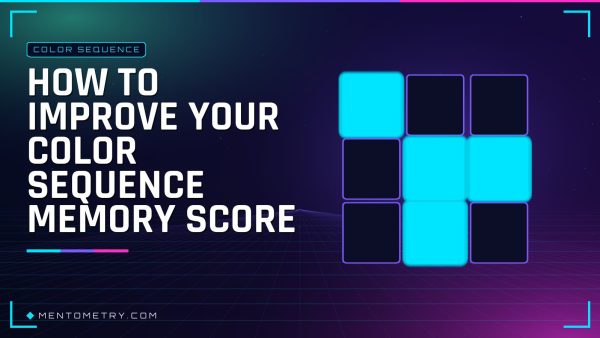
Related tasks can give you variety while keeping some cognitive demands familiar. Grid Memory emphasizes remembering highlighted cells and reproducing their pattern. Color Sequence emphasizes watching a color sequence and repeating it in the same order. These tasks may exercise overlapping attention and memory processes, but they are not identical to reversing a sequence.
Use them as cross-training in the everyday sense: a way to avoid boredom and practice related skills. Do not assume that a higher result in one automatically raises your Reverse Memory score. Transfer is usually stronger when the practiced and tested tasks share important features, and weaker when their demands differ substantially. (pubmed.ncbi.nlm.nih.gov)

If you want to stay close to the core demand, spend most of your focused practice on Reverse Memory. Add a related game when you want a change of pace or a way to practice attention without repeating the exact same challenge.
Color Sequence can be useful for comparing memory for ordered information with memory for manipulated information. In Color Sequence, you repeat the sequence in the same order; in Reverse Memory, you must transform the order before responding. That contrast can help you notice whether your main difficulty is holding a sequence or reorganizing it.
- Variety can make practice easier to sustain.
- Related tasks may share attention or memory demands.
- Comparing tasks can help you identify strategy weaknesses.
- Different tasks do not guarantee transfer.
- Time spent elsewhere is time not spent on Reverse Memory.
- A strong score in a simpler or different task may create false confidence.
Measure progress like a player, not like a gambler
Personal-best scores are exciting, but they are noisy. A single result can be affected by attention, fatigue, distractions, response caution and chance variation. To understand improvement, track a small set of measures rather than only the highest number.
- Typical score: The result you commonly achieve, not your one best attempt.
- Consistency: How widely your results vary within a session.
- Error type: Whether you lose items, reverse incorrectly or rush.
- Condition: Whether you were rested, distracted or fatigued.
- Practice dose: How often you practiced and whether sessions were spaced.
Compare blocks of practice rather than isolated rounds. For example, compare your typical performance from one week with your typical performance from the next. If the average rises while your error pattern becomes more controlled, that is more convincing than a single dramatic score.
Also watch for a plateau. A plateau may mean that your current strategy has reached its useful limit, that your practice is too repetitive, or that fatigue is masking small gains. Try changing one factor: shorten sessions, space them more widely, return to accuracy practice or test a different chunking method.
For the next seven days, record one typical result and one best result after each practice session. At the end, compare both—not just the personal best.
ALSO READ How to Improve Your Color Sequence Memory Score
What improvement can—and cannot—mean
A better Reverse Memory score can mean that you have learned the task, improved your response strategy, become more familiar with the required manipulation, or developed more stable attention during the game. Those are worthwhile achievements. They show that focused practice can refine performance on a demanding cognitive task.
But a score gain does not automatically mean higher intelligence, better memory in every situation, or improved performance at school or work. Studies of working-memory training often find task-specific or near-transfer benefits, while far transfer to unrelated measures is smaller, inconsistent or absent depending on the design. (pubmed.ncbi.nlm.nih.gov)
The honest way to describe your progress is precise: “I improved at this reverse-sequence task,” or “I became more consistent when holding and reordering short sequences.” If you want broader cognitive benefits, use skills in real activities that matter to you, such as reading carefully, solving problems, learning material and managing information in context. Reverse Memory can be a useful challenge, but it should not carry claims that the evidence does not support.
A practical Reverse Memory plan
Here is a compact plan that combines the principles above without turning practice into a second job.
- Choose three to five practice days. Keep sessions short enough that attention remains deliberate.
- Begin with a consistent warm-up. Settle your attention, then move into focused rounds.
- Prioritize accuracy. Do not force speed while order errors are common.
- Identify one error pattern. Decide whether you need better encoding, holding, reversal or response control.
- Test one strategy. Try small chunks or position labels only if they make the sequence easier to manage.
- Record typical performance. Include a brief note about fatigue and distractions.
- Space the sessions. Return after a break to check whether the improvement holds.
- Use related games sparingly. Add variety, but keep Reverse Memory as the main practice target.
- Take rest seriously. A tired session can be practice, but it is not the fairest score test.
The best approach is steady rather than dramatic. Treat each session as a level in a longer campaign: learn the demand, make one adjustment, keep your accuracy intact and let improvement accumulate.
Conclusion
Improving at Reverse Memory is mostly a matter of disciplined attention. Practice deliberately, space your sessions, use chunking when it genuinely helps, protect sleep, and respect the speed-accuracy trade-off. Track typical performance instead of worshipping one high score, and keep transfer claims modest. The goal is not to make one game prove everything about your mind; it is to become better at a specific challenge through informed, repeatable practice.
Player Two: Games to Try Next
Hand-picked from Mentometry and the Brain Games directory, matched to this article.
 Logic Puzzles · Memory GamesBrainova: IQ Test & Logic GameFALCON GAME★ 4.7 (23K votes)View ratings & details ▶
 Sudoku & Number Grids · Memory GamesSudoku – Exercise your brainReachJunction Media Limited★ 4.8 (702 votes)View ratings & details ▶
 Puzzle Games · Memory GamesJigsaw Puzzle – GamesTwepple Technologies LLP★ 4.8 (4.1K votes)View ratings & details ▶
Frequently Asked Questions
How can I improve my Reverse Memory score?
Practice in short, focused sessions and prioritize accuracy before speed. Use deliberate practice, spaced sessions, a consistent warm-up and a simple strategy such as chunking when it genuinely helps.
Is Reverse Memory a working-memory test?
It challenges working memory because you must hold a sequence while mentally reversing its order. Your score also reflects attention, strategy and response control.
Does chunking improve backward memory?
Chunking can help by grouping items into manageable units, especially when the sequence supports clear groupings. It is a strategy, not proof that your general memory capacity has increased.
Should I play Reverse Memory every day?
Daily practice is not required. Short sessions spread across several days may be more useful than one long, tiring session because spacing supports retention and makes progress easier to assess.
Can Reverse Memory improve my intelligence?
No conclusion that broad intelligence automatically increases is justified. Improvements are most likely to appear on the practiced task or on closely related tasks, while transfer to unrelated abilities is limited and debated.
Why is my score lower when I am tired?
Fatigue and poor sleep can reduce attention and increase working-memory errors. Treat tired sessions as a different testing condition rather than as a definitive measure of your ability.
Sources
- Deliberate Practice and Performance in Music, Games, Sports, Education, and Professions: A Meta-Analysis / Psychological Science
- Spacing Repetitions Over Long Timescales: A Review and a Reconsolidation Explanation / Frontiers in Psychology
- The Speed-Accuracy Trade-Off: History, Physiology, Methodology, and Behavior / Frontiers in Neuroscience
- Working Memory Training Revisited: A Multi-Level Meta-Analysis of N-Back Training Studies / Psychonomic Bulletin & Review
- Does Far Transfer Exist? Negative Evidence From Chess, Music, and Working Memory Training / Psychological Science
- Reviewing Working Memory Training Gains in Healthy Older Adults: A Meta-Analytic Review of Transfer for Cognitive Outcomes / Neuroscience & Biobehavioral Reviews
- Working Memory Training Involves Learning New Skills / Journal of Memory and Language
- Sleep On It / National Institutes of Health
Educational content, not medical or financial advice.